
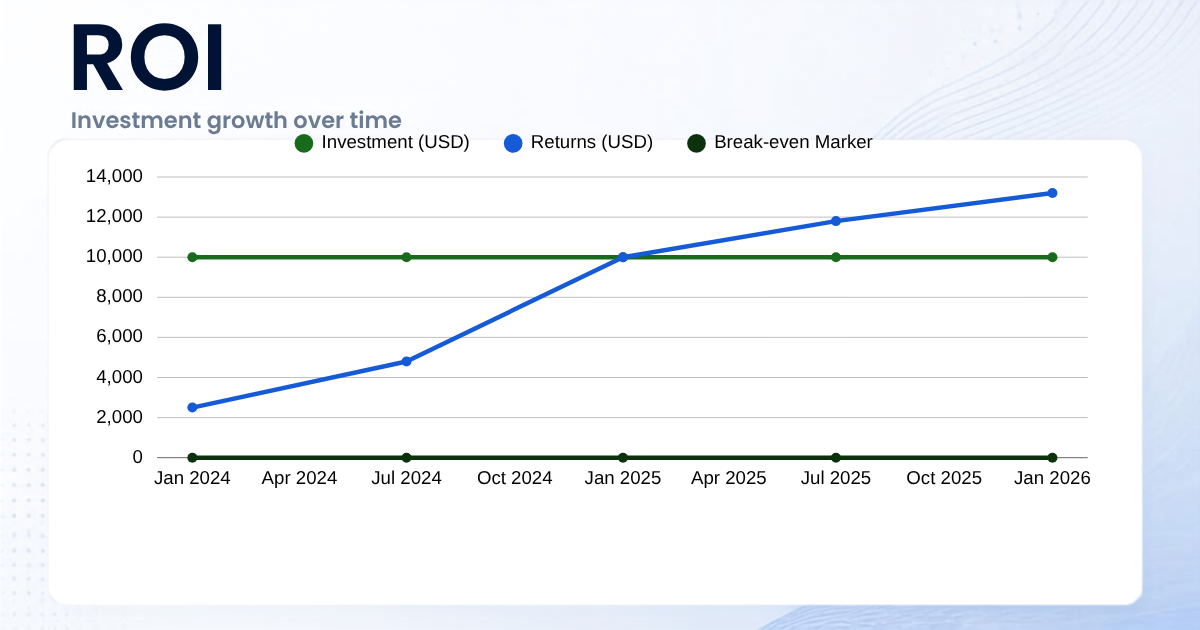
L&D has a credibility gap with finance, which costs good platforms their budget renewals. Nearly every executive wants proof that learning investment pays off, but almost none of them are getting it in language the business trusts: 94% of executives demand clear ROI from learning investments, while only 11% of L&D teams effectively measure business impact.[1] That's a colossal eighty-plus point credibility chasm between what the board expects and what most learning functions can currently produce when asked to defend their budget. Closing that gap isn't a is absolutely critical to keeping your platform funded after the end of the first contract, and it's what determines whether L&D gets a seat in the budget conversation or gets treated as a discretionary line item to cut when times get tight.
Start With the Number That's Easiest to Defend
The temptation in any ROI conversation is to reach for the most impressive figure available. Take a breath, and do this instead.
Start with the number that's hardest to argue with: delivery efficiency. Switching from instructor-led training to a platform-based model cuts direct delivery costs in ways that are simple to trace — no venue hire, no travel and subsistence, no facilitator day rate multiplied across every cohort. A modest $150 per-employee saving in delivery costs works out to $750,000 in annual efficiency gains for a 5,000-person organisation[2] — often more than the LMS itself costs annually, which means the platform can, in the right circumstances, pay for itself on delivery savings alone before any of the harder-to-quantify benefits are even counted. In this example, you're moving from defending a "frivolous" investment to showing how your buying decision paid for itself within twelve months - very different framing.
This is the number to lead with in a board conversation, not because it's the biggest, but because it's the most defensible. A CFO can independently verify a delivery-cost calculation using your own headcount, your own current spend on venues and travel, and your own facilitator rates. It doesn't require trusting a vendor's marketing claim or a third-party study's methodology because your own finance team can rebuild from scratch and validate the arithmetic themselves.
What Independent Analysis Says
Once the efficiency case is established, independent, third-party analysis can extend the picture so long as the right caveats are attached. A 2024 Forrester Total Economic Impact study of a mainstream enterprise LMS, based on interviews with real customers, found a 490% return on investment and $11.8 million in net present value[3] over the study period. That's a striking number, and it's worth citing to your board as one well-documented case study. That said, it's important to be precise about what it is and isn't. It's a vendor-commissioned study of a specific enterprise deployment, at a specific scale, with a specific set of use cases. It is not a universal guarantee that any LMS purchase, at any size, will produce anything close to that return. Presenting it as "the industry standard ROI" rather than "one credible, independently-verified case study" is the kind of overclaim that erodes exactly the finance credibility L&D is trying to build.
Simpler, in-house ROI calculations also hold up, and arguably travel better with a sceptical finance audience precisely because it's more modest. One published L&D ROI worked example showed a positive ROI of 66.67%, meaning every $1 spent returned $1.67[4]. Another walked-through case, based on comparing pre- and post-training performance metrics, arrived at a 25% LMS ROI once total benefits were weighed against total costs[5]. Neither of these numbers will make a headline. Both are far more useful in a genuine budget conversation than an unqualified 490%, because they're built from a methodology a finance team can interrogate and replicate with their own figures.
The Retention Angle Is Underrated
The retention angle is where ROI gets consistently underrated, and it's worth spending real time on in any business case, because it tends to be the largest single line item once an organisation actually runs the numbers. PayPal estimated that cutting employee turnover by just 1% would save around $500,000 a year[6] through reduced productivity loss, reduced recruitment cost, and reduced retraining spend for replacement hires. That's a calculation any finance team can plug their own headcount, average salary, and estimated cost-per-hire into — and for most organisations, even a modest reduction in voluntary turnover attributable to better development opportunities dwarfs the delivery-cost savings on its own. As any L&D professional worth their salt will tell you, employee training is a key driver to hit this retention target.
Companies with comprehensive employee training programmes report 24% higher profit margins[2] than those without a strong learning culture. This is genuinely worth including in a business case, but it's equally worth flagging its limits honestly: this is a correlational finding, not proof that training alone drives the margin difference. Organisations that invest heavily in training also tend to have other characteristics — stronger management practices, healthier cash positions that allow for investment, lower turnover to begin with — that independently correlate with higher margins. Presenting the 24% figure as pure causation, rather than a meaningful but imperfect signal, is the kind of statistical overreach that a sharp CFO will spot immediately and that undermines the rest of the case.
Building a Case That Actually Survives Scrutiny
The lesson for procurement and L&D alike: build your ROI case on your numbers — delivery cost deltas calculated from your own current spend, time-to-competency measured against your own baseline, attrition costs modelled with your own headcount and salary data — using the frameworks above as a template, not a substitute. Boards trust a modest, well-sourced 25% far more than an unsubstantiated 490%, because the modest number survives the follow-up question, and the unsubstantiated one doesn't.
I know from working with L&D and HR professionals for almost 20 years that this is a conversation we are constantly having in one way or another, and candidly, it's one where we are not always most comfortable. We may tell ourselves that numbers aren't our thing or that the benefits are there, just not tangible enough to quantify. However, it's something we can train, just like anything else, and it's an investment which will pay off; exactly like your LMS procurement/ renewal decision when done right.
A genuinely useful ROI case has three layers: the hard-to-dispute efficiency savings, a credible retention or productivity estimate built from the organisation's own data, and — only as supporting colour, never as the headline — third-party benchmarks that show what's achievable elsewhere. Get the order right, and the LMS renewal conversation stops being an annual argument and starts being a formality.
References
[1] https://www.disprz.ai/blog/steps-to-assess-ld-expenses-roi
[2] https://www.continu.com/blog/measuring-enterprise-lms-roi
[3] https://tei.forrester.com/go/absorb/lms
[4] https://elearningindustry.com/lms-roi-measuring-costs-and-benefits
[6] https://www.getbridge.com/blog/lms/proving-roi-learning-development-stats/